
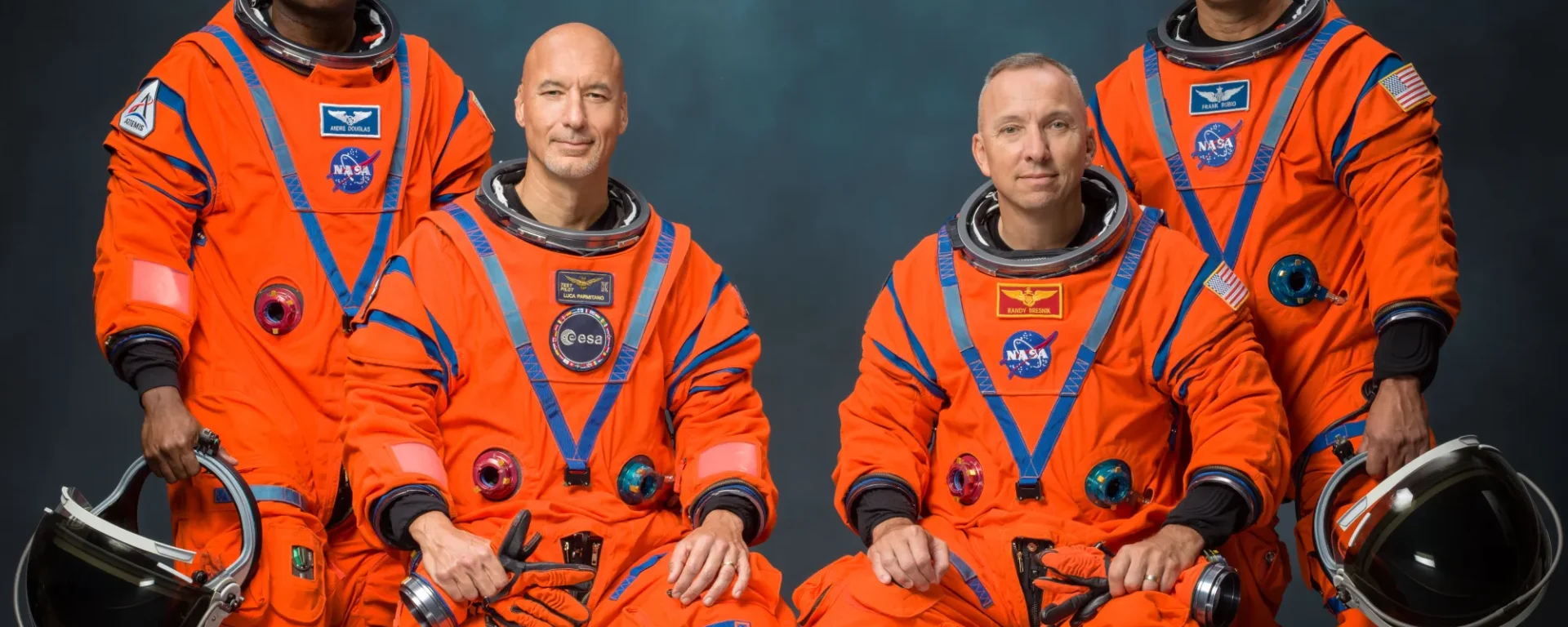
NASA officially named the four-member crew for its Artemis III mission on Tuesday, unveiling a team of veterans and specialists for a test flight scheduled for 2027. The agency also detailed a strategic shift in mission architecture. Artemis III will now function as a two-week “pathfinder” mission in low Earth orbit (LEO), serving as an essential rehearsal for human-rated docking systems. This mission is designed to ensure that commercial flight hardware can successfully interface with the Orion spacecraft before the agency attempts a crewed lunar landing during Artemis IV in 2028.
A Reservoir of Operational Experience
The primary crew for Artemis III represents a cross-section of military and scientific expertise. Commander Randy Bresnik, a retired U.S. Marine colonel and former International Space Station (ISS) commander, will lead the flight. Joining him as pilot is the first European assigned to an Artemis mission, Luca Parmitano of the European Space Agency (ESA).
Parmitano is an Italian Air Force colonel and veteran ISS commander. He is widely considered a premier choice for this experimental flight. His suitability is underscored by his composure during a 2013 spacewalk, where he successfully navigated a life-threatening helmet leak that nearly resulted in an orbital drowning. This level of experience in high-stakes, “scary” situations is vital for a mission utilizing an unproven flight profile.
The team also includes Mission Specialists Frank Rubio and Andre Douglas. Rubio is a U.S. Army physician and aviator who holds the American record for the longest single-duration spaceflight. Douglas is a U.S. Coast Guard Reserve Commander and systems engineer embarking on his first mission. NASA astronaut Bob Hines will serve as the backup crew member.
While the caliber of the crew is a highlight for the program, the announcement felt crowded by a dense barrage of hardware logistics. To many observers, the historic nature of naming the first Artemis crew with an international partner deserved to take center stage. Instead, the crew shared the spotlight with technical minutiae that at times overshadowed the human element of the mission.
The Strategy for Orbital Integration
The mission profile for Artemis III involves a highly choreographed series of launches and docking events in LEO. The agency’s Space Launch System (SLS) rocket will launch the Orion spacecraft to meet two separate target vehicles already waiting in orbit. This allows for the first crewed test of the docking systems required for a lunar landing.
The first phase involves a rendezvous and two-day docking with a Blue Origin lander test article. During this time, the crew will check life support, hatch operations, and zero-gravity suit procedures. Orion will then detach to dock with a SpaceX Starship pathfinder for an additional 24-hour testing period. While in orbit, the crew will also act as mission scientists, studying space weather and atmospheric data while refining contamination control protocols.
This orbital focus extends into the revised plans for Artemis IV. SpaceX announced that for the 2028 landing mission, Starship will now dock with Orion in Earth orbit to perform the trans-lunar injection (TLI). By utilizing the lander’s massive propulsion to push both spacecraft toward the Moon earlier in the flight, NASA aims to improve fuel efficiency and overall crew safety.
Hardware Milestones and Organizational Cadence
NASA confirmed that hardware integration for these missions remains on schedule. Engineers plan to connect the Orion crew and service modules this summer. Technicians at the Kennedy Space Center are also continuing to integrate the SLS core stage with four RS-25 engines. To further test launch procedures and improved cryogenic seals, NASA will roll out a shortened SLS stack this fall.
However, the agency’s communication strategy drew some skepticism during the briefing. NASA officials announced a new, more frequent cadence for these live public events. The implication that every departmental update will be staged as a full-scale event—rather than a standard press update—appears unnecessary. There is concern that treating routine progress with this level of production may eventually dilute the impact of historic milestones, such as the crew announcements made today. The success of the program will now depend on whether this veteran crew can effectively navigate the complex orbital dance required to return humanity to the lunar surface.